Anthropic × Samsung — Why Every Frontier AI Lab Ends Up Building Its Own Silicon
Learn In Depth · Agentic AI / AI Infrastructure · Deep Dive · July 2026
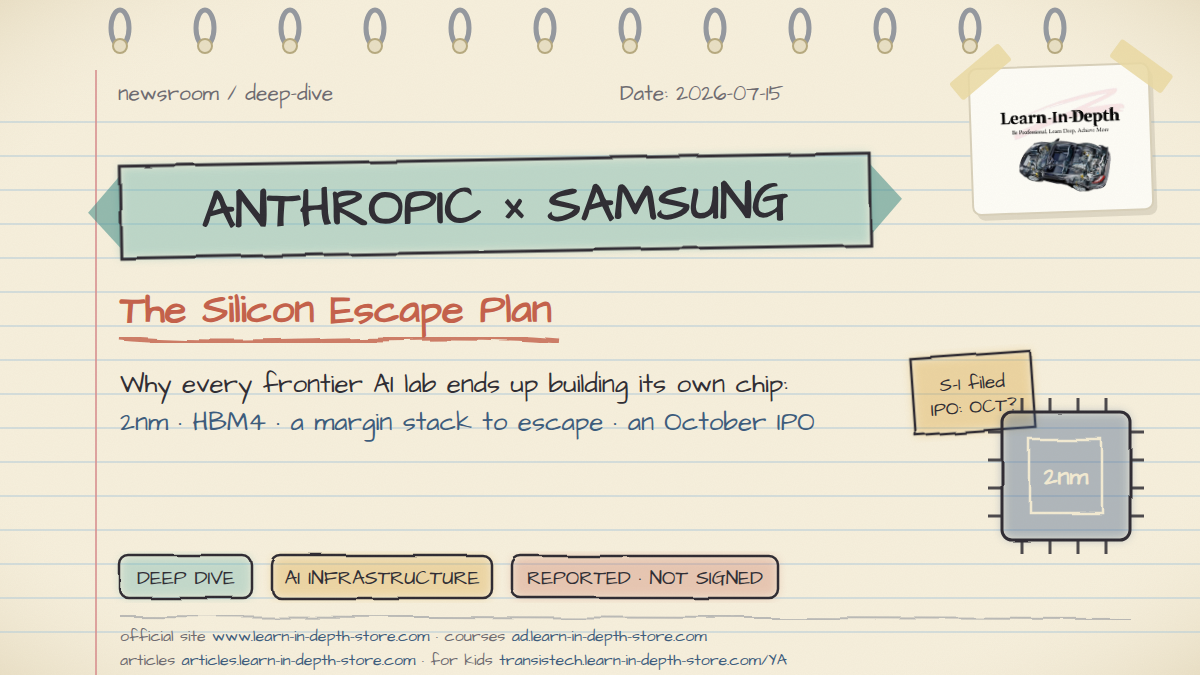
Picture this: you run a company whose product is intelligence itself. Your revenue is reportedly running at $30 billion a year. And yet, every single token your models generate pays rent to somebody else — because you don't own a single square millimeter of the silicon your business runs on.
Worse: two of your biggest chip suppliers are also your investors. And also your competitors.
Then, on July 2, 2026, The Information drops a report: Anthropic is in talks with Samsung to manufacture its first custom AI chip — on Samsung's 2-nanometer process. One month earlier, on June 1, Anthropic had quietly submitted a confidential draft S-1 to the SEC, with reports pointing to a listing as early as October.
Two headlines. One story. Let's take it apart, piece by piece.
SectionThe Blueprint
- What actually happened
- The question nobody asks: why would a model lab design chips?
- Follow the money: the margin stack
- The pattern: everyone before them did the same thing
- The engineering layer: what a custom inference chip actually optimizes
- Why Samsung — and why not TSMC
- The IPO connection
- Who wins, who loses
- The synthesis
Section1. What actually happened
Strip the noise, and there are exactly two verified facts:
Fact one — the chip talks. The Information reported (and TechCrunch, Bloomberg, and The Korea Herald confirmed the outline) that Anthropic is in early-stage discussions with Samsung Electronics about a collaboration on a custom AI chip, targeting Samsung's 2nm foundry process and advanced packaging. How early? This early: per the reporting, Anthropic "hasn't yet decided what the chip will be used for, how it will fit into the server, or how powerful it will be." No signed deal. No tape-out date. A direction, not a product.
⚠️ Honesty box: everything about this chip is "in talks," sourced to reporters, not to a signed contract. Treat every detail below as reported, not announced. Anthropic's only official comment was that its "diversified hardware stack — chips from Google, Amazon, and Nvidia — is pivotal to its compute strategy."
Fact two — the IPO clock. Anthropic confirmed on its own newsroom that it confidentially submitted a draft S-1 registration to the SEC on June 1, 2026. Multiple outlets report the target window for the actual listing is as early as October 2026 — which would make it one of the largest tech IPOs in history, and would beat OpenAI to the public markets.
Hold both facts in your head at the same time. That's the whole trick of this story.
Section2. The question nobody asks
Why on earth would a model company — a lab whose crown jewels are weights and research talent — burn years and billions designing silicon?
You might ask: isn't Nvidia enough? Anthropic trains on GPUs, on Google's TPUs, on Amazon's Trainium. Supply is flowing. And you might add: designing a frontier accelerator is a graveyard of failed projects — ask anyone who watched the dozens of AI-chip startups of the last decade.
Good objections. Now let's dismantle them.
Section3. Follow the money: the margin stack
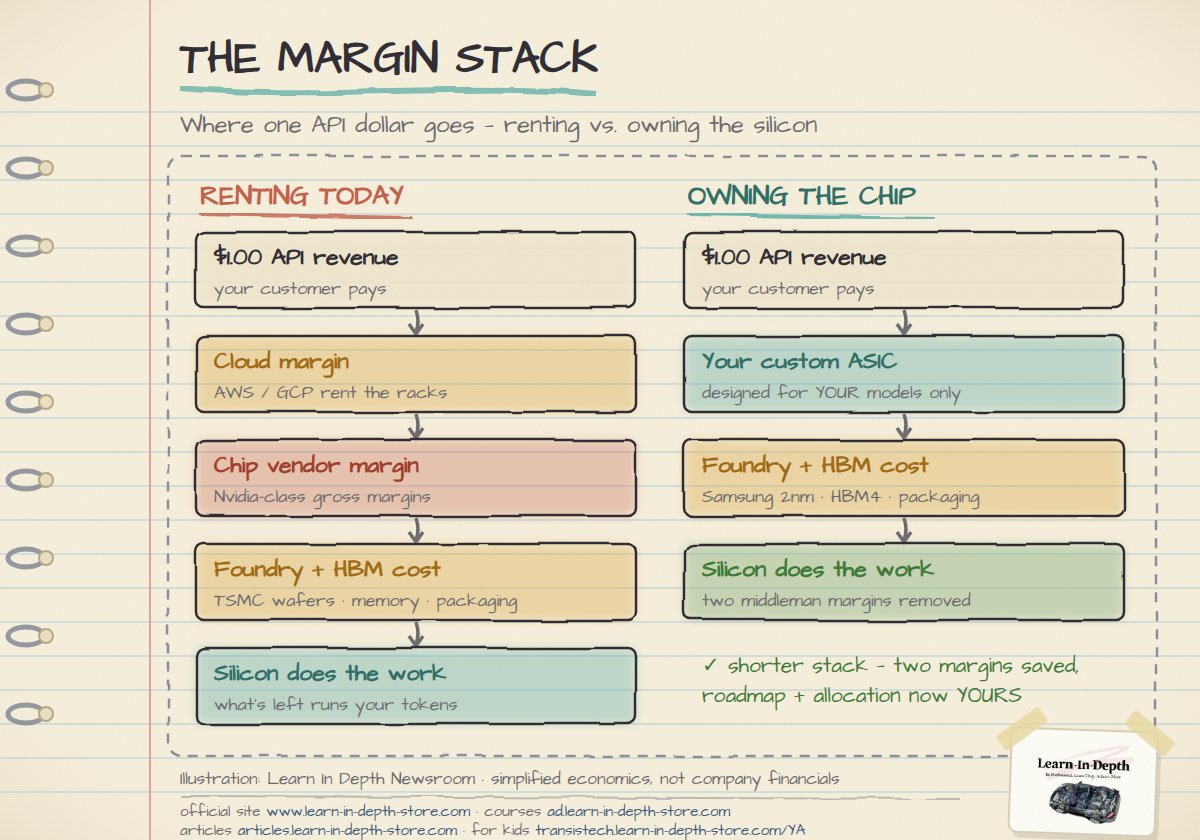
Every token Claude generates today travels through a stack where every layer takes a cut:
Your API dollar
 └── Cloud provider margin (AWS / GCP rent)
 └── Chip vendor margin (Nvidia's famously fat gross margins)
 └── Foundry cost (TSMC wafers, HBM, packaging)
 └── Actual silicon doing the work
At small scale, this is fine — it's called "buying a service." At Anthropic's scale, it's an economics problem. Look at the reported numbers stacked up over the last nine months:
- October 2025: Google Cloud deal reported in the tens of billions — access to up to ~1 million TPUs, gigawatt-scale capacity.
- April 2026: an expanded Anthropic × Google × Broadcom agreement for ~3.5 GW of next-generation TPU compute; the same reporting cycle put Anthropic's run rate around $30B.
- Ongoing: the Amazon partnership — Project Rainier's Trainium fleets — expanding toward up to 5 GW of additional capacity.
Here's where you say: "So they already have diversified, cheaper-than-Nvidia compute. Problem solved, no?"
Sounds nice. But no — and this is the point most coverage misses. Renting someone else's custom silicon solves the Nvidia margin problem, but it creates three new ones:
- Someone else's roadmap. TPU features land when Google's priorities say so. Trainium's compiler matures at Amazon's pace. Your model architecture bends to their silicon, not the reverse.
- Someone else's allocation. When compute gets scarce, guess whose workloads get cut last? The owner's. (This very week, reports surfaced of Google capping a major customer's Gemini-era compute requests — capacity is the new oil.)
- Someone else's leverage at the negotiating table. Google and Amazon are Anthropic's investors, suppliers, and rivals — simultaneously. Every renewal negotiation happens against companies that know exactly how dependent you are.
A custom chip is not about saving 20% on a wafer. It's about owning the bottom of your own stack — the roadmap, the allocation, and the negotiating position.
Section4. The pattern
This isn't a novel move. It's the fourth or fifth rerun of the same movie:
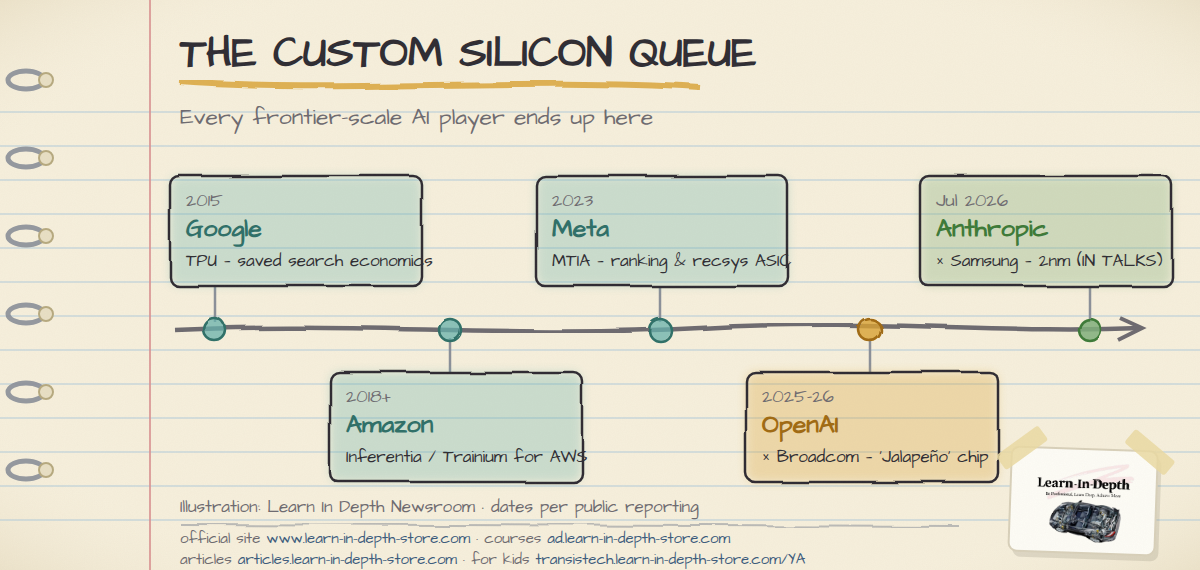
- Google, 2015: deploys the first TPU because scaling search-era inference on CPUs/GPUs would have broken the economics of the business. Today the TPU is the backbone of its AI empire — and a product it sells.
- Amazon: builds Inferentia and Trainium so AWS margins don't leak to Nvidia forever.
- Meta: ships MTIA, its in-house inference accelerator, for ranking and recommendation at planetary scale.
- OpenAI, 2025–26: partners with Broadcom on a custom processor — the recently disclosed inference chip reported under the codename "Jalapeño" — with claims of superior performance-per-watt.
- Anthropic, July 2026: opens talks with Samsung.
See the pattern? At frontier scale, custom silicon stops being an optimization and becomes survival. Every lab that reached this size either built its own chip or started to. Anthropic is the last frontier lab without one. That's not a coincidence; that's a queue.
Section5. The engineering layer
Now let's put on the engineering hat, because "custom AI chip" hides the actual technical decision.
Training and inference want different silicon. Training is compute-hungry: you want maximum FLOPS, giant interconnect domains, and you can tolerate batch latency. Inference — especially the decode phase of an LLM serving billions of requests — is a different animal: generating each token means streaming the model's weights and the KV-cache through the chip, over and over. Decode is overwhelmingly memory-bandwidth-bound, not compute-bound.
That's why the real spec sheet of an inference ASIC is written around three things:
- HBM bandwidth per dollar — the memory wall is the product. This is also why the memory makers suddenly sit at the center of AI geopolitics.
- Performance-per-watt — at gigawatt scale, the electricity bill is a first-order cost. Note that performance-per-watt is exactly the metric OpenAI chose to brag about for its Broadcom chip. Nobody picks that metric by accident.
- The compiler stack — the graveyard of AI chips is not full of bad silicon; it's full of good silicon with unusable software. Nvidia's real moat is CUDA. Google survived because of XLA. Amazon fought for years to mature Neuron. If Anthropic does this, its advantage is unusual: it only has to compile one family of workloads — its own models. A vertical lab doesn't need a general-purpose ecosystem; it needs one perfect path from PyTorch/JAX to its own tensor cores.
💡 Engineer's mental model: a general-purpose GPU is a city bus — it goes everywhere, and you pay for that flexibility. A custom inference ASIC is a metro line built under your own commute: one route, no traffic, brutal efficiency — and useless for anyone else's journey. The question is only whether your commute has enough passengers to justify digging the tunnel. At ~$30B run rate, it does.
Section6. Why Samsung
Here's where the story gets geopolitically delicious. If you're designing a 2nm-class chip, the "safe" answer is TSMC. So why is the reporting about Samsung?
Because the safe answer is sold out. TSMC's leading-edge nodes and advanced packaging are booked solid by Nvidia, Apple, AMD, and — irony alert — the other custom-chip programs. Tight supply pushes newcomers to the alternative.
And because Samsung is hungry in a way TSMC hasn't been for decades. The numbers from the Korea Herald's coverage tell the story: Samsung holds roughly 4% of the global "Foundry 2.0" market versus TSMC's ~38%. Its foundry president, Han Jin-man, publicly frames a return to profitability "by 2028." A hungry foundry gives anchor customers what a dominant one never will: priority, pricing, and flexibility. Tesla's multibillion-dollar AI-chip manufacturing deal with Samsung set the precedent; Nvidia and Apple already tie parts of their pipeline to it.
And one more card only Samsung holds: it's the only company on Earth that is simultaneously a leading-edge logic foundry and a top-tier HBM memory house. Re-read section 5: inference silicon is a memory-bandwidth product. A partner who can co-design the 2nm logic die, the HBM4 base die, and the advanced packaging under one roof is offering something TSMC structurally cannot. It's probably no coincidence that Anthropic's May announcement named the major memory chipmakers as "strategic infrastructure partners."
The risk column, to be fair: Samsung's advanced-node yield history is exactly why it has 4% and not 20%. Betting a frontier chip on SF2 is a real gamble — for both sides. Which is precisely why, for Samsung, landing Anthropic would be a redemption arc, not just a purchase order.
Section7. The IPO connection
Now connect fact two. Why do the chip talks surface five weeks after a confidential S-1?
Because an IPO of this scale is a story sold to public markets, and the story has a hole in it: "our COGS is other people's margins, forever" is a terrifying line in an S-1. Every gigawatt Anthropic rents makes the revenue line beautiful and the gross-margin line ugly. A credible path to first-party silicon — even one that's years out — rewrites the long-term margin narrative from "we pay the Nvidia/cloud tax indefinitely" to "we are compressing the stack like Google did."
Public capital also solves silicon's other problem: custom chips are a rich company's game. Design teams, multiple steppings, 2nm mask sets, HBM4 supply commitments — this is billions before the first token. An October listing and a chip program aren't two news items. They're one strategy reported by two desks.
Section8. Who wins, who loses
- Samsung Foundry — the biggest potential winner: a frontier-lab anchor tenant for 2nm + HBM4 + packaging, and proof it can host the era's defining workloads.
- Broadcom & the ASIC ecosystem — every lab that goes custom validates the "hyperscaler ASIC" business model (and Anthropic already sits inside a Google/Broadcom TPU pipeline — its design-partner shortlist writes itself).
- Korea — SK Hynix already feeds the HBM boom; an Anthropic-Samsung axis would put both Korean giants at the center of AI infrastructure.
- Nvidia — loses nothing today (it sells every chip it makes), but watches another future ex-customer walk down the same exit ramp Google, Amazon, Meta, and OpenAI took.
- TSMC — unbothered operationally, watchful strategically: if Samsung's 2nm redemption arc works because TSMC had no room at the inn, the duopoly dynamics of the 2030s just changed.
- The wildcard loser: any AI lab without $30B of revenue and gigawatt deals. The table stakes of the frontier just went up again.
Section9. The synthesis
So what does all of this actually mean?
First: the frontier AI race has quietly become a vertical integration race. Models were the moat in 2023; compute contracts were the moat in 2025; owning the silicon roadmap is the moat being built for 2028.
Second: inference economics — not training glory — is driving the silicon decisions. Memory bandwidth per dollar per watt is the metric that will decide who profits from AGI-scale serving.
Third: Samsung just became the most interesting swing player in AI infrastructure. Foundry + HBM4 + packaging under one roof is a hand nobody else holds.
Fourth: the IPO and the chip are the same story. One funds the other; the other justifies the first.
Fifth: for you as an engineer — the stack is re-verticalizing. The winners of the next five years are the people who understand the whole path from token to transistor: model architecture, KV-cache behavior, compiler stacks, HBM, packaging. "Full-stack" is about to mean something much deeper than frontend + backend.
And the question I leave you with: when Anthropic's S-1 goes public in October, will there be a chip program inside it — and will Samsung's 2nm line finally get its redemption arc, or does this story end the way most custom-chip dreams do: quietly, in a footnote?
Sources
- The Information — Anthropic in Talks With Samsung to Manufacture Custom AI Chip (original report, July 2, 2026)
- TechCrunch — Anthropic is discussing a new custom chip with Samsung
- Bloomberg — Anthropic in Talks With Samsung for Custom AI Chip
- The Korea Herald — Samsung in talks to produce Anthropic's advanced AI chips
- Anthropic — Confidential draft S-1 submission
- CNBC — Anthropic confidentially files IPO prospectus with SEC
- CNBC — Google and Anthropic announce cloud deal worth tens of billions (Oct 2025)
- The Register — Anthropic reveals $30bn run rate, plan to use new Google TPU
- Anthropic — Expanded partnership with Google and Broadcom (multi-GW)
- Anthropic — Amazon collaboration up to 5 GW
Written by the Learn In Depth Newsroom. All chip-deal details are based on press reporting as of July 15, 2026 — the Samsung collaboration is under discussion, not a signed agreement.
Learn In Depth — Go deep, not wide.
🌐 Official Site · 📚 Courses · 📰 Articles · 🧒 For Kids — TransisTech
© 2026 Learn In Depth · Written by the Learn In Depth Newsroom
Comments